
As within, so without
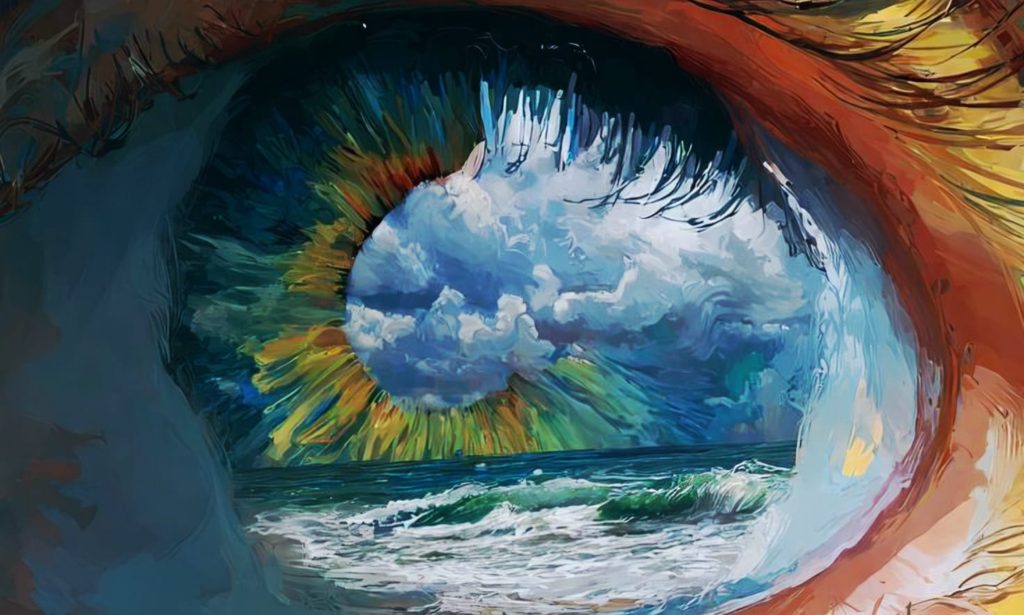
Featured art: unknown
I have been falling down this rabbit hole of Hermetic philosophy and I have been discovering so many old and fascinating texts that I never knew existed. I am trying to digest and interpret everything I have been reading about lately, to make my own meaning of it. However, one concept I feel ready to discuss a bit on my blog is from a legend – an ancient text called the Emerald Tablet of Hermes.
The Emerald Tablet is a short, cryptic and enigmatic text traditionally attributed to a legendary Hellenistic figure, combining both aspects of the Greek god Hermes and the Egyptian god Thoth, Hermes Trismegistus (also known as ‘Hermes the Thrice-Greatest’). The Emerald Tablet seems to be a poetic summary of early alchemical belief, its first mentions comes from the Book of the Secrets of Creation and the Art of Nature (Kitāb sirr al-ḫalīqa) attributed (apparently) to Apollonius of Tyana (referred to as Balīnūs as well) dating back to around 6th – 8th century CE, no later than the 11th century CE.
The Book of the Secrets of Creation and the Art of Nature was first published in Arabic, however it’s theorized that it was translated into Arabic from Greek and Syriac. From the research I’ve been doing, it seems that there is no English translation as of yet, only some in French, although I managed to find an abridged version in English done by Jason Colavito, that I recommend you go read.
The way the legend goes is that Balīnūs finds a vault underneath the statue of Hermes, in the city of Tyana, upon understanding the meaning of the scripture on the statue:
“I am Hermes, to whom knowledge has been given; I have made this wonderful work in public, but afterward I hid the secrets of my art, so that they can only be discovered by a man as learned as I am.” On the breast of the statue one could similarly read these words written in ancient language: “If anyone wishes to know the secret of the creation of beings, and in what way nature has been formed, he should look under my feet.”
–
(Pseudo-) Apollonius of Tyana (Balīnūs)
c. fifth century CE
Inside the vault, Balīnūs finds an old man seated on a golden throne holding in one hand “a tablet of emerald” on which was written: “This is the formation of nature.”
There have been many translations made of the Emerald Tablet, some notable ones done by Isaac Newton, Julius Ruska and Jabir ibn Hayyan, to name a few. Here you can view all the different translations of the Emerald Tablet, but for the purpose of this blog, I will be using the translation done by Henry Carrington Bolton.
The Emerald Tablet of Hermes
1) I speak not of fictitious things but of that which is most certain and true.
2) Whatsoever is below is like that which is above, and that which is above is similar to that which is below to accomplish the miracles of one thing.
3) And as all things were produced by the meditation of one Being, so all things were produced from this one thing by adaptation.
4) Its father is Sol, its mother Luna; the wind carried it in its belly, the earth is its nurse.
5) It is the cause of all perfection throughout the whole earth.
6) Its power is perfect, if it be changed into earth.
7) Separate the earth from the fire the subtile from the gross, acting prudently and with judgment.
8) Ascend with the greatest sagacity from the earth to heaven, and then again descend to the earth, and unite together the powers of things superior and things inferior.
9) Thus you will possess the glory of the whole world, and all obscurity will fly far away from you.
10) This thing has more fortitude than fortitude itself, because it will overcome every subtile thing and penetrate every solid thing.
11) By it this world was formed.
12) Hence proceed wonderful things which in this wise were established.
13) For this reason I am called Hermes Trismegistus, because I possess three parts of the philosophy of the whole world.
14) What I had to say about the operation of Sol is completed.
–
Balinas
Kitāb sirr al-ḫalīqa
8th century CE
trans. Henry Carrington Bolton
The whole Emerald Tablet is fascinating. It, alongside the Book of the Secrets of Creation and the Art of Nature, are where some of the first scientific, astrological, philosophical and alchemical ideas are mentioned.
As the translations of the Emerald Tablet started to spread throughout Europe from the 12th century onward, it started to gain a lot of attraction by scholars and commentators. Some, such as Hortulanus, interpreted it as a “foundational text” of alchemical instructions for producing the philosopher’s stone. Others, including Isaac Newton and Carl Jung, interpreted it as a source of esoteric or psychological knowledge.
What I would like to focus on, however, is the second line in the Emerald Tablet, and is also one of the seven Hermetic principles:“Whatsoever is below is like that which is above, and that which is above is similar to that which is below to accomplish the miracles of one thing.” It is the concept of the macrocosm and the microcosm; that what happens in “great” things are mirrored in “small” things. This became the philosophical backbone for astrology, alchemy and correspondence-based magic in general.
Different variations of this quote have been made, the most popular being: “As above, so below, as within, so without, as the universe, so the soul,” and is often attributed to Hermes Trismegistus himself.
I love this quote, because I truly do believe that it all starts within. As within, so without. We are the creators of our reality, life does not happen to us, it comes from us. When you align with your soul and feel connected from within, it will be reflected back to you outward. If you can connect to your own heart, you can connect to the hearts of others, you can connect to the heart of the Earth and to life itself.
We are all connected to each other, as we are made from the same matter. Alan Watts and Carl Sagan popularized this concept:“We are the universe experiencing itself.” As above, so below. We are made from stardust; from the carbon in our muscles, to the oxygen in our breath; from the calcium in our bones, to the iron in our blood; the atoms in our body are from dying stars.
We are all descendants of the stars; we were all made from the same light and shadows. In this day in age, I think it can be very easy to estrange ourselves from one another, especially as we witness the acts of cruelty and injustice done by others of our race. Even while writing this, the idea of being connected to tainted souls like that fills me with revulsion, it almost makes me want to reject this concept entirely.
However, as I’m able to acknowledge my own darkness, I can therefore acknowledge the darkness of others without flinching. Because I’ve looked within, because I’ve found my light through my darkness, I can actualise it without, regardless of those who prefer to remain ignorant to their truth. Our world can truly change for the better, but it all starts with you, within your own soul. Learn who you are, study your darkness, examine your pain and The Miracle is yours.
As the universe, so the soul.
Thank you so much for reading my blog! I hope you found the legends of Hermetic philosophy as interesting as I do, there is still so much for me to learn and interpret. I tried to do this piece of history justice in regards to its impact and importance.
Even though I had a lot of fun writing this, there were times that I felt like I was going out of my mind, losing brain cells trying to articulate this. So I hope you enjoyed!
I learnta lot from this piece, Macrocosm and microsm. Great articulation👌👌👍
Within You, Without You is also a good song by The Beatles.
I am a Bard firstly, an Alchemist and Polymath since elementary. I have several books on Alchemy but it is a practice as well as a tradition. This is the complete Spagyric book (herbalism refined). The Practical Handbook of Plant Alchemy. An Herbalists Guide to Preparing Medicinal Essences, Tinctures, and Elixirs. Manfred M. Junius
I am a Bard firstly, an Alchemist and Polymath since elementary. I have several books on Alchemy but it is a practice as well as a tradition. This is the complete Spagyric book (herbalism refined). The Practical Handbook of Plant Alchemy. An Herbalists Guide to Preparing Medicinal Essences, Tinctures, and Elixirs. Manfred M. Junius
That’s so cool, thank you for the recommendation!
We may not share the same philosophy, but I truly enjoy the glimpse from your view. Beautifully written. Thank you so much for sharing a piece of your soul!
Wow, what an incredible deep dive! You articulated this beautifully. I absolutely love the principle of ‘As within, so without’
Dear
Thanks for liking my ordinary post, This : II today.
Your liking the post has always encouraged me. 🙏🌹
Dear
What a beautiful post
Thank you for liking my post Anthology. 🙏
It can be very difficult to make the unseen comprehensible through words. Still well done. You pushed through it and others benefited.
You should buy some witchcraft books, cuz it’s a WHOLE forgotten history. I identify as a Shaman, and check out the Spanish Inquisition’s Ethnic Cleansing of Shamanism
Dear Avoeria
What a beautiful post.
Thanks for liking my post Current
Your encouragement is precious.
Greetings on Rakhi Pournima, Indian festival celebrating love of brother and sister 🌹🙏
I have bookmarked the translations. Thank you. It’s very fascinating! 🙂
Absolutely loved this!!
I really enjoyed reading this. The idea of light and darkness existing not as opposites that cancel each other out, but as necessary parts of a whole, resonated with me deeply. It’s a theme I return to again and again in my own writing, and this part immediately made me think of Jung: “How can I be substantial if I fail to cast a shadow? I must have a dark side also if I am to be whole.”
I especially loved this line: “We are all descendants of the stars; we were all made from the same light and shadows.” Beautifully put. There is something very human in the idea that accepting our darkness does not mean surrendering to it, but understanding it and transforming it into something else. Thank you for such a thoughtful exploration.
I’ve been thinking about this a lot too lately, I would like to write more about it. I love how you put this into words, thank you! <3
I’d love to read more if you do.
This blog post is worth reading.
Thought provoking and interesting. It reminds me how we are created for eternity and our souls are created in the image of our creator, and of words from Matthew 18 – Truly I tell you, whatever you bind on earth will be bound in heaven, and whatever you loose on earth will be loosed in heaven.
My friend, you did the topic justice with your writing. The Emerald tablets was one of the first writings I copied into my spiritual journal. I still read it often and it still fascinates after 26 years. So even though I am well acquainted, I still enjoyed reading your blog entry.
I love this.
I’ve read the tablets both in German and English (as a dual citizen who first lived most of her life in Europe before she moved to America). It’s been a long time though and I feel inspired to read this again.
Thank you for your post, I love connecting with other like-minded souls!